Expert Help for OCD

Take Your Life Back from OCD
Offering expert treatment for all types of OCD, including unwanted obsessional thoughts. Our OCD treatment program is typically 10 weeks. We offer twice-weekly sessions, groups, and intensive programs. Intensive program can be in person or online. Low cost options available. Contact us...
Behavioral Wellness Clinic
392 Merrow Rd, Suite E,
Tolland, CT 06084
Office: (860) 830-7838
OCDTYPES
Obsessive-compulsive disorder comes in many forms
About Obsessive-Compulsive Disorder (OCD)
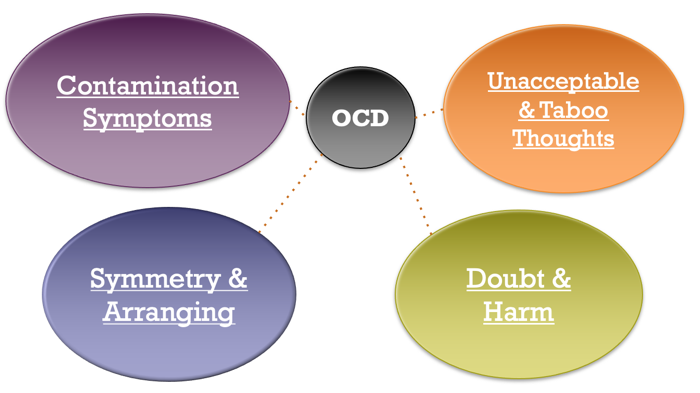
Obsessive-compulsive disorder (OCD) is a brain-based anxiety-related disorder that causes considerable suffering that can interfere with all areas of life. OCD has many symptom profiles, also called OCD subtypes or OCD symptom dimensions.
What's an Obsession?
In OCD, obsessions are ideas, thoughts, impulses, or images that keep coming back. They are not enjoyable, rather obsessions are unwanted and upsetting, causing severe anxiety or distress. The content of these obsessions is sometimes grouped into different areas, including: aggression (fears of harming others), contamination (fears of being dirty), sex, religion, and exactness. What separates OCD obsessions from normal obsessions experienced by everyone are the frequency, intensity, and discomfort. OCD sufferers attach much greater meaning and threat to these thoughts than others. The obsessions won't just "go away."
What's a Compulsion?
In order to cope with the obsessions, people with OCD engage in repeated behaviors or thoughts, known as compulsions, to make themselves feel safer. Compulsions are rituals that the person believes reduce the risk of the obsessions coming true, or at least reduce the anxiety they produce. However, the compulsions are not really useful. They do not prevent the feared consequence or are clearly excessive. Compulsions or rituals take up so much time that they get in the way of work, school, and family obligations.
Source: Ruscio, A. M., Stein, D. J., Chiu, W. T., & Kessler, R. C. (2010). The epidemiology of obsessive-compulsive disorder in the National Comorbidity Survey Replication. Molecular Psychiatry, 15, 53-63.
OCD has a wide range of varied symptom profiles. The table above presents a list of the most common obsessions and compulsions, as reported in the National Comorbidity Survey Replication (NCS-R), a nationwide survey, illustrating the breadth of symptom expression. Among those with OCD, 19% reported symptoms in just one area shown, but 15% reported symptoms in two areas, 9% noted concerns in three areas, 30% had concerns in four areas, and 27% identified concerns in five or more areas. This makes it very clear that many people with OCD have more than one OCD type.
Types of OCD
Researchers have classified the many symptoms of OCD into four major categories:
- Contamination and Washing
- Doubts About Accidental Harm and Checking
- Symmetry, Arranging, Counting, and Just Right OCD
- Unacceptable Taboo Thoughts and Mental Rituals
People can have more than one type of OCD. Learn about the four types of OCD.
OCD and a Pandemic
Covid-19 has been stressful and triggering to germaphobes everywhere, and at the same time, exposure based treatment has never been so challenging. Treating OCD has entered uncharted territory due to the everpresent and real threat of COVD-19. OCD sufferers who've had seemingly irrational fears have suddenly become rational, and people without OCD are cleaning and sanitizing well beyond the normal standard prior to the pandemic. The good news is that it is still possible to do exposure-based therapy in a safe and effective way. Contact the New England OCD Institute for more info.